

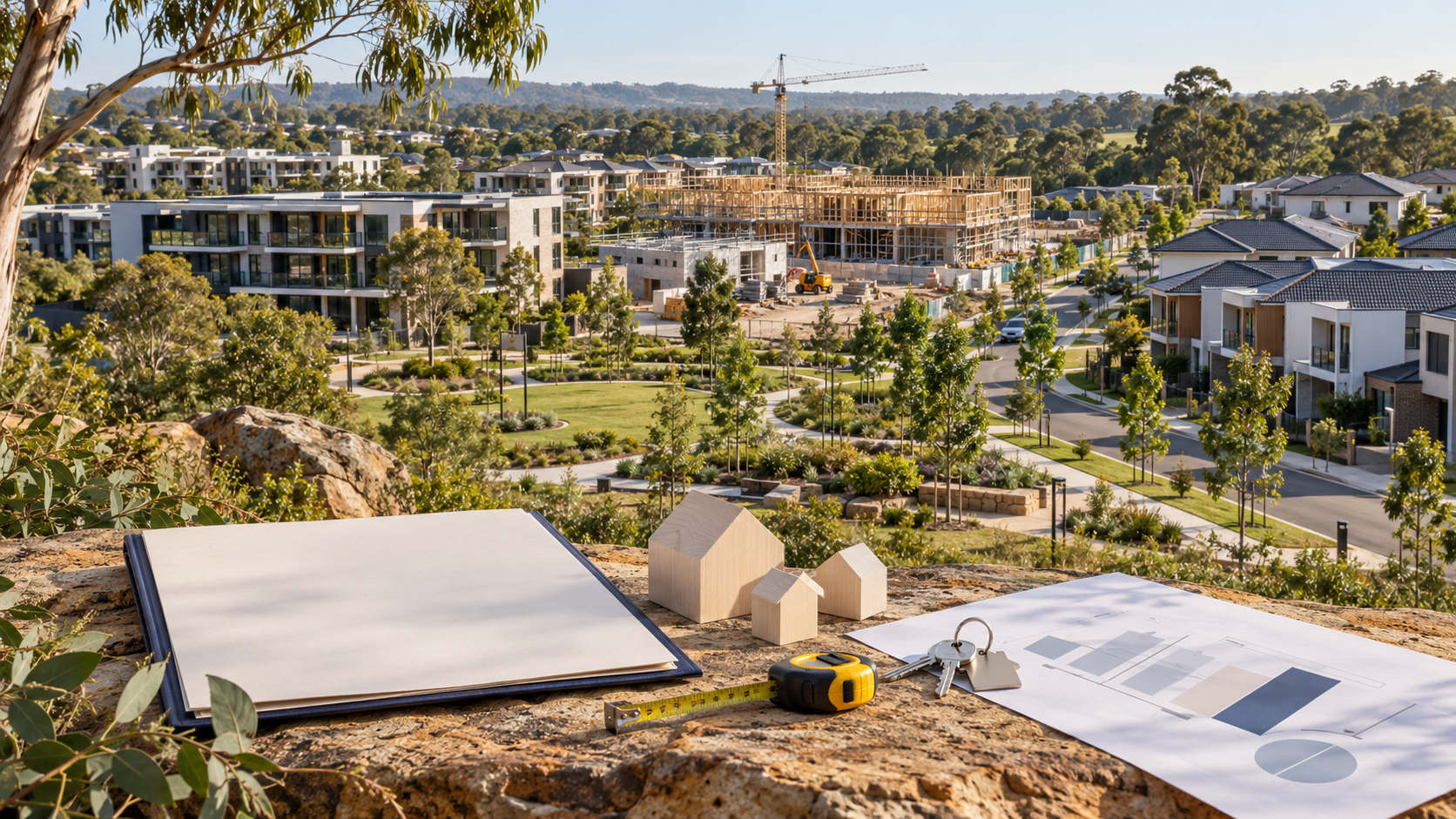
Building approvals fell in August: what a thinner supply pipeline means for NSW property decisions
Australia's housing pipeline has become an important part of the property conversation. The latest building approvals release shows a sharp monthly fall in total dwelling approvals, while the mix between houses and higher-density homes shifted noticeably. For NSW buyers, sellers and investors, the useful question is how supply, finance and local demand interact in the suburb being considered.
This article is general information only and is not legal, financial, credit or tax advice. Speak with an appropriately qualified professional about your circumstances.
What the August approvals data shows
The Australian Bureau of Statistics reported that total dwelling approvals fell 6.1 per cent in August 2026 to 16,953 on a seasonally adjusted basis. Private sector house approvals rose 3.7 per cent to 10,885, but private sector dwellings excluding houses fell 21.2 per cent to 5,674. The value of residential building also edged down 0.6 per cent to $11.30 billion.
One month does not define the future supply of a suburb. Approvals also take time to become completed homes, and not every approval proceeds immediately. The numbers do, however, reinforce why buyers should look beyond a broad shortage or oversupply headline and inspect the actual pipeline around a target location.
Why the property type matters
A stronger flow of detached-house approvals does not have the same effect as a large pipeline of apartments, terraces or townhouses. Competing stock, construction timing, infrastructure, rental demand and resale depth can vary significantly between property types. A buyer comparing two suburbs should ask what is already approved, what is under construction and which projects are likely to reach the market at a similar time.
Three practical checks for NSW buyers and sellers
- Review council and planning information for major nearby projects, not just the current listing supply.
- Compare the property's type, floor plan, land component and likely buyer or tenant pool with future competing stock.
- Stress-test repayments, holding costs and the timing of a potential sale rather than relying on a single market forecast.
What this means for decisions now
The RBA's cash rate target was 4.60 per cent after the 30 September 2026 decision, so finance remains part of the supply discussion. Domain's Sydney results for the week to 10 October recorded a 46 per cent clearance rate, showing that demand is not uniform across campaigns. A careful local comparison can therefore be more useful than assuming every new approval will either weaken or support prices in the same way.
For buyers, the goal is to understand the future competition around a property. For sellers, it is to position the campaign against the homes buyers can realistically choose. For investors, it is to consider whether future stock may affect vacancy, rent and resale conditions.
Sources
News insight
 Oct 19, 2026
Time on market is becoming a bigger buyer signal in Sydney
Why Sydney buyers and sellers should compare time on market with local property evidence.
 Oct 18, 2026
Older listings are building up: what Sydney sellers should review before relaunching
A practical guide for Sydney sellers reviewing pricing, presentation, campaign feedback and competin...
 Oct 17, 2026
Sydney housing values have fallen for six months: what buyers and sellers should check now
Sydney housing values have fallen for six consecutive months. The latest data makes property type, l...